Overboost cont.
Info & FAQProductsRidesSupportContact Us

1.8T 
1.8T Overboost 
Overboost cont. 
1.9 & 2.0 TDI 

VW Overboost Solution kit explanation

First off, lets cover a few basics of the turbo system.

This applies to all conventional turbo systems, and probably covers 95% of the turbo cars on the road.
You need to understand that a wastegate actuator opens when pressure is applied. An open wastegate holds your boost level at that point. A closed wastegate does nothing to regulate pressure. An engine at idle doe not produce boost. When you accelerate or put a load on the engine, exhaust flow spins the turbine which compresses air to produce boost. By diverting exhaust flow away from the turbine and out the exhaust you regulate the boost pressure. This is the function of the wastegate and its actuator. The wastegate actuator controls the position of the wastegate and how much of this exhaust flow is used to produce boost.

The wastegate actuator is a simple mechanical device. Pressurize the hose leading to it and it begins to open the wastegate. In the examples below we'll assume the wastegate is fully open at 10psi. So that's it, once boost reaches 10psi the wastegate is wide open and your not going to get any more boost. Looking at the first diagram below, the path of airflow is show by the red line. (Boostvalve is set to an opening over 10psi so its not doing anything). The VW N75 boost solenoid is passing all air through it and directly to the wastegate.

Air flow 0-10 psi

So how do we get more boost?

We (well actually Volkswagen's engineers)divert some pressure away from the actuator, so that boost in the engine is actually more than the pressure at the wastegate actuator. As airflow approaches the wastegate actuator a percentage is allowed an alternate path via a boost control solenoid (the N75 in our case). The more air flowing out the solenoid and NOT to the gate, the more boost you get, remember the actuator only works from 0-10psi, once at 10psi, its wide open and your boost isn't going any higher. But, since pressure in the manifold is actually higher your peak boost is higher than 10. The dotted line is the vent exiting the N75 which is routed back into the air intake path before the turbo. (This by the way is a lot like how a bleeder valve works)

air flow 10 psi and up

But if we chip the car, and or mod it so that airflow is altered, we now may run into a problem. The N75 may react too slowly and vent off too much boost. Or the computer may be telling it to open too much. If this happens your going to see a spike or too much peak boost. The actuator needs 10psi to fully open and hold the boost. If it doesn't get to 10psi, boost seen in the engine and on your gauge is too high

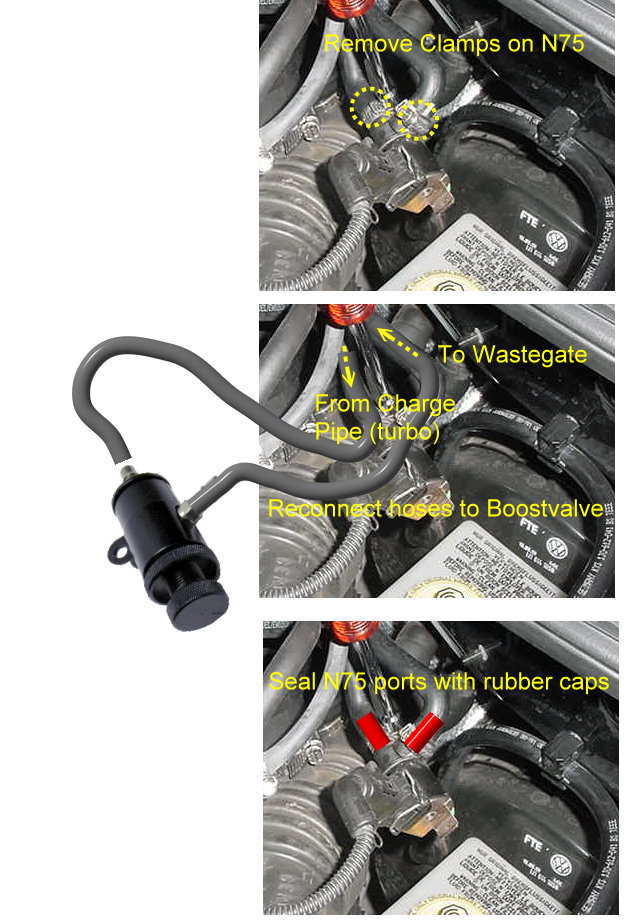
This is where the Boostvalve is used to reduce the spike or hold boost in check. The computer is telling the N75 to open but now we give the airflow a path through the Boostvalve as an alternate and direct path to the actuator. By adjusting the Boostvalve you control how much air gets to the gate regardless of what the computer is telling the N75. This is what our OverBoost kit does. It takes a Boostvalve boost controller and connects so that you get rid of the surges and spikes. Loosening the adjuster on the Boostvalve allows more air to flow through the Boostvalve and directly to the wastegate actuator, lowing boost. Tighten the Boostvalve all the way and its essentially closed and the computer is back in control of all airflow.

OverBoost Solution

So what's the disadvantage?

Your max boost is controlled by the chip/computer. The Boostvalve can't raise boost above what the chip is telling the N75 to allow. If you need more boost you need another way of raising the boost.


[Previous][Next]

Copyright (c) 2008 Ric Gillis' Boostvalve. All rights reserved.

info@boostvalve.com